

Did you know that over 50,000 screenplays are registered with the Writers Guild of America every year, yet only a handful ever get produced? You’re not alone if you’ve ever wondered how to turn your idea into a movie script.
Writing a screenplay might initially seem overwhelming, but it’s not as impossible as it looks. With the right structure and guidance, anyone can learn the craft.
This step-by-step guide will give you everything you need to confidently write, finish, and polish your very first script.
What Is a Movie Script?
A movie script (or screenplay) is the written blueprint for a film. It contains dialogue, actions, characters, and settings, everything that happens on screen.
Unlike novels, scripts are visual and lean. They focus on what can be seen and heard, not what characters are thinking.
Industry standards matter: most scripts are written in Courier 12-point font, with 1 page equaling about 1 minute of screen time.
Step-by-step Script Writing
Writing a script can feel like staring at a blank page with no idea where to begin. The good news? You don’t need to figure it all out at once.
Scriptwriting works best when you break it down into small, clear steps. Think of it like telling a story to a friend: you start at the beginning, build up the drama, and finish with a satisfying ending.
By following a step-by-step approach, you’ll take the pressure off and actually enjoy the process of bringing your story to life.
Step 1: Understand the Fundamentals of Screenwriting
Before you write a single word, familiarize yourself with what a movie script is. A screenplay is not a novel; it’s a blueprint for a visual medium. It focuses on what the audience sees and hears, not internal thoughts.
Key Elements of a Screenplay
- Scene Headings (Sluglines): Indicate location and time, e.g., “INT. COFFEE SHOP – DAY” (INT. for interior, EXT. for exterior).
- Action Lines: Describe what’s happening visually, in the present tense and active voice. Keep them concise—3-4 lines max per paragraph.
- Character Names: Centered and in uppercase when introducing dialogue.
- Dialogue: What characters say, placed under their name.
- Parentheticals: Rare instructions for how dialogue is delivered, like (whispering).
- Transitions: Like “CUT TO:” or “FADE OUT,” used sparingly in modern scripts.
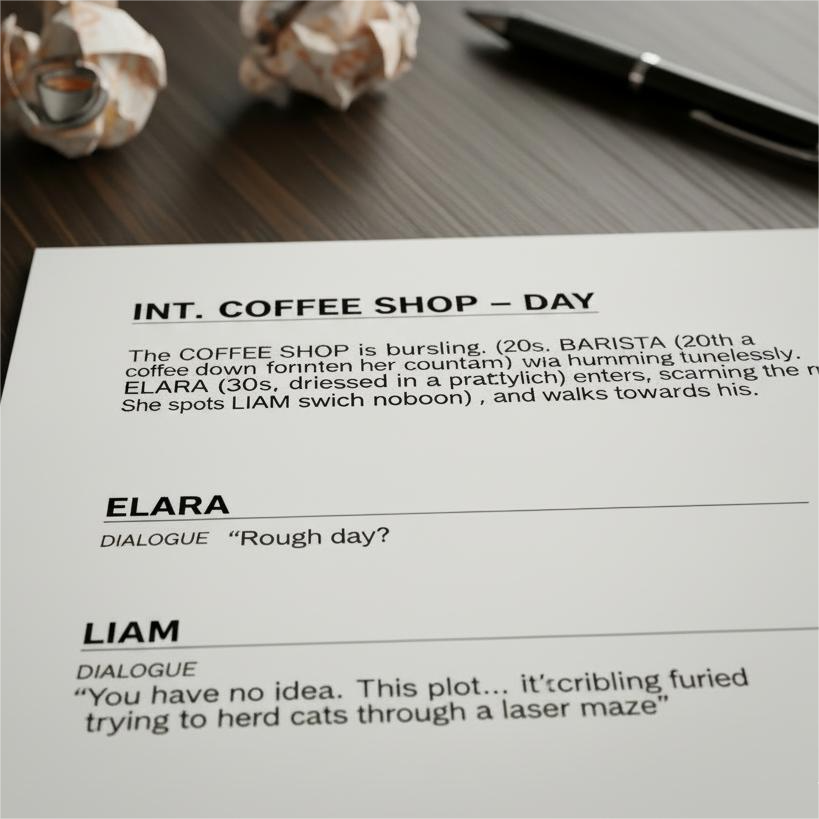
A standard feature-length script is 90-120 pages, with one page roughly equaling one minute of screen time.
Use software like Final Draft, Celtx (free version available), or even Google Docs with screenplay templates to handle formatting automatically.
Step 2: Brainstorm and Develop Your Idea
Every script starts with a spark. Begin by jotting down ideas without judgment.
Finding Your Concept
- Logline: Craft a one-sentence summary that hooks: “A [protagonist] must [goal] or else [stakes].” Example: “A young wizard must destroy a powerful ring to save his world from an evil lord.”
- Genre and Tone: Decide if it’s comedy, drama, horror, etc. Mix genres for originality, like rom-com with sci-fi elements.
- Theme: What deeper message do you want to convey? Love conquers all? The dangers of ambition?
Spend time freewriting or mind-mapping. Ask: What if? Why? How? This phase might take days or weeks; don’t rush.
Common Pitfall: Avoid clichés. Twist familiar tropes; e.g., instead of a standard superhero, make them reluctant or flawed in unexpected ways.
Step 3: Build Compelling Characters
Characters drive the story. Audiences connect with people, not plots.
Character Development Essentials
- Protagonist: Your hero with clear wants, needs, and flaws. Give them an arc, how do they change by the end?
- Antagonist: Not just evil; they should have motivations that clash with the protagonist’s.
- Supporting Cast: Friends, mentors, or foils who highlight the main character’s traits.
Create character profiles:
- Background: Age, job, history.
- Personality: Strengths, weaknesses, quirks.
- Motivations: What do they want? Why?
- Relationships: How do they interact with others?
Use a table for quick reference:
| Character | Role | Arc | Key Trait |
| Hero | Protagonist | From coward to brave | Witty sarcasm |
| Villain | Antagonist | Descent into madness | Charismatic manipulator |
| Sidekick | Ally | Learns independence | Loyal but naive |
Beginner Tip: Base characters on real people you know, but exaggerate for drama. Ensure diversity and avoid stereotypes.
Step 4: Outline the Plot Structure
A strong outline prevents writer’s block. Most movies follow a three-act structure, inspired by Syd Field’s paradigm.
Three-Act Breakdown
- Act 1 (Setup, ~25% of script): Introduce the world, characters, and inciting incident (the event that kicks off the story). End with the first plot point, committing the protagonist to the adventure.
- Act 2 (Confrontation, ~50% of script): Rising action with obstacles, subplots, and midpoint (a major twist). Build tension to the second plot point, leading to the climax.
- Act 3 (Resolution, ~25% of script): Climax where conflicts peak, followed by falling action and denouement (wrap-up).
Flesh out your outline with beat sheets—key scenes or “beats.” For a 100-page script:
- Act 1: Pages 1-25
- Act 2: Pages 26-75
- Act 3: Pages 76-100
Include twists, reversals, and emotional highs/lows. Tools like index cards or software (e.g., Scrivener) help rearrange beats.
Pro Tip: Ensure conflict escalates. Each scene should advance the plot or reveal character—cut anything that doesn’t.
Step 5: Write the First Draft
Now, the fun (and scary) part: writing!
Drafting Strategies
- Set a goal: Aim for 1-3 pages per day.
- Write “FADE IN:” at the start and “FADE OUT” at the end.
- Focus on dialogue that sounds natural—read it aloud.
- Show, don’t tell: Instead of “He’s angry,” show him slamming a door.
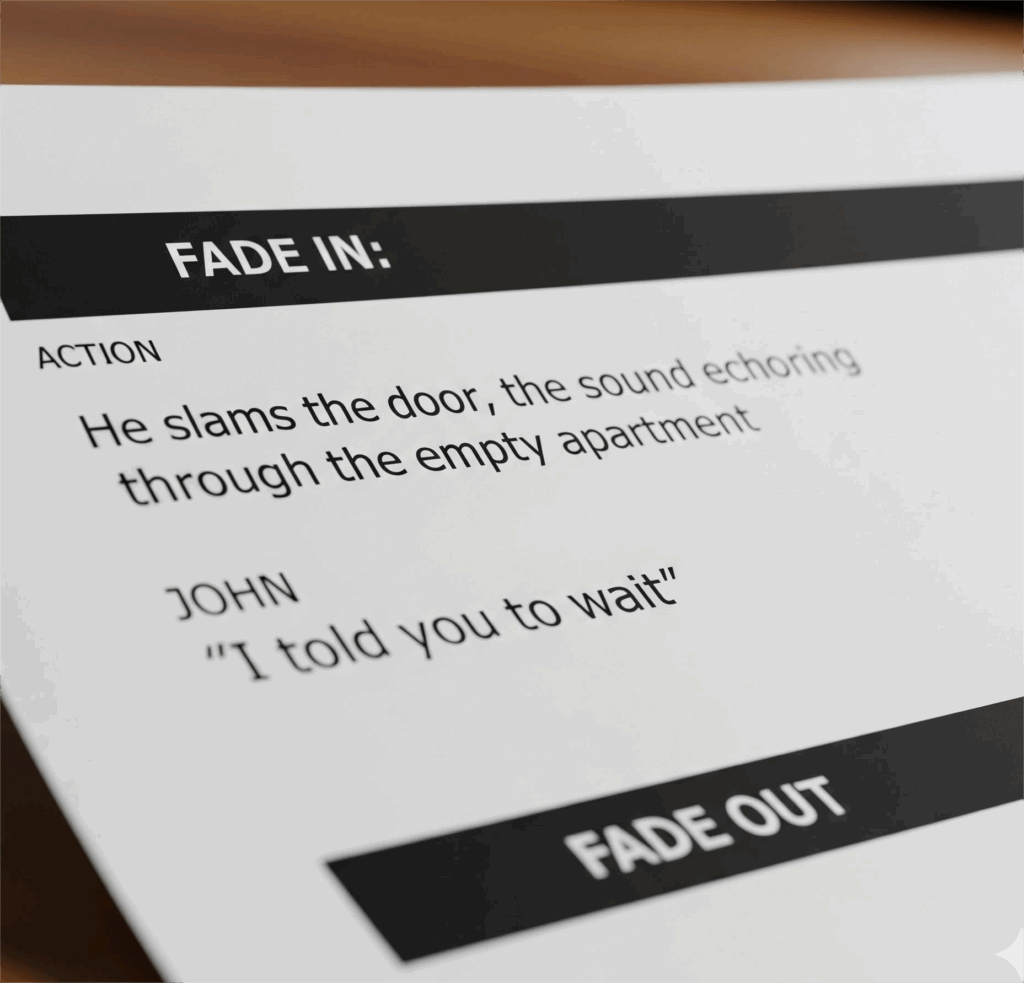
Ignore perfection; the first draft is about getting words down. It might be messy, and that’s okay.
Block distractions, use apps like Freedom, or write in sprints (e.g., Pomodoro technique: 25 minutes focused, 5-minute break).
Length Guide: Short films: 5-30 pages; Features: 90+ pages.
Step 6: Revise and Edit
No first draft is ready. Revision turns good into great.
Revision Process
- Take a Break: Step away for a week to gain perspective.
- Big Picture Edits: Check plot holes, pacing, and character consistency. Does the story flow? Cut unnecessary scenes.
- Line Edits: Tighten dialogue, improve descriptions. Aim for economy—every word counts.
- Proofread: Fix grammar, typos, and formatting errors.
Read aloud or use text-to-speech tools to catch awkward phrasing. Track changes in your software.
Common Edits:
- Strengthen stakes: Make consequences feel real.
- Balance action/dialogue: Too much talk? Add visuals.
- Endings: Ensure resolution satisfies without being predictable.
Step 7: Format and Polish for Submission
Professional formatting is crucial, agents and producers notice.
Standard Formatting Rules
- Font: Courier 12-point.
- Margins: 1 inch all around.
- Page Numbers: Top right, starting from page 2.
- Title Page: Centered title, your name, contact info.
Use software to automate this. If submitting, research guidelines (e.g., via The Black List or contests like Nicholl Screenwriting Competition).
Tip: Register your script with the WGA (Writers Guild of America) or copyright it for protection.
Step 8: Seek Feedback and Iterate
Fresh eyes spot issues you miss.
Getting Feedback
- Share with trusted friends, writing groups, or online forums like Reddit’s r/Screenwriting.
- Hire a script consultant if possible.
- Ask specific questions: “Does the ending work?” “Is the protagonist likable?”
Incorporate notes thoughtfully; not all feedback is equal. Revise again based on patterns in critiques.
Final Push: Enter contests or pitch to producers via platforms like Stage 32.
Conclusion:
Writing a movie script is a journey of creativity, persistence, and learning.
By following this step-by-step guide, you’ve got the tools to craft a compelling screenplay from scratch.
Remember, rejection is part of the process, even legends like Spielberg faced it. Keep writing, revising, and believing in your story. Who knows? Your script could be the next big hit.
Start today: Grab a notebook, brainstorm that idea, and “FADE IN.” Happy writing!